Written by I’m Mina Kurt, who is currently doing her Master’s degree in law at the University of Tartu.
Every morning you wake up, you open your eyes to a million possibilities. Most days we don’t feel them. We wake up with the alarm, the inbox, the list of things we are supposed to be. But the possibilities are there, quietly, whether we look at them or not.
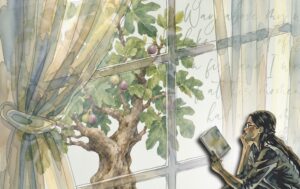
Recently, I’ve been reading ‘The Bell Jar’ by Sylvia Plath, and there’s a passage that has taken over my mind: the fig tree. Esther imagines her life branching out before her, each branch holding a fig, and each fig a different future: a husband, a career, a home, love, art, fame, a life fully lived. She sits beneath the tree and cannot choose. And because she cannot choose, the figs begin to wrinkle, blacken, and fall to the ground, one by one, until she is left with nothing.
I think almost every woman has sat under that tree at some point in her life, even if she’s never read the book.
The tree is not the problem
What stays with me about the passage is how generous the tree is. The branches are heavy, the fruit is plump and purple, and there is nothing else a person could ever want. Esther sits beneath that tree, surrounded by seemingly limitless possibilities.
Yet she starves. The tragedy of the scene is not the tree. It is that she looks at all that fruit and hears a rule: take one, and the rest will be taken from you. She never asks who made this rule. Just obeys it.
It describes a feeling many of us know without having words for it: standing in front of a full life and being unable to reach, not because the fruit is out of range, but because reaching for one fig feels like a betrayal of all the others. As if you could only have one.
Esther counted the figs
Esther sees a husband and children on the tree. A famous poet. A brilliant professor. An editor. A traveller. An Olympic champion. It is an impressive list, and every item on it is a role that already exists, with a name, a job title, and a place in a story someone has told before.
Her imagination is enormous, yet even she is limited by the possibilities she can name.
We talk about options as if they were a finite list, like a vending machine with a few buttons: press one, lose the rest. But the list has never been fixed. Many professions that exist today began as something nobody could have hung on a tree a hundred years earlier. Entire industries, art forms, and ways of spending a day appeared out of nowhere, and the people who first did them had no “template” to follow. Most of the lives that will be worth living in thirty years do not have names yet.
When we stand under the tree and see only the figs we can name, we are not looking at our future. We are looking at other people’s pasts.
The fear underneath
If the tree is this generous, why is reaching so hard? I think the answer is fear, and it is a reasonable one.
Reaching for a fig means risking that you won’t get it. Say out loud that you want something, and you might be refused in front of people. Wanting something specific makes you visible, and visible people can be criticised.
There is even a kind of safety in the paralysis Esther felt. As long as you haven’t chosen, you haven’t failed. As long as every fig is still hanging there, every future stays perfect, untested, unspoiled. Sitting under the tree can feel like caution, even wisdom.
My mum wrote me a letter when I was leaving for college and slipped it into my bag. In it, she wrote, “Of course it is really nice to be together and spend time, but for you to go out and discover yourself, I need to give you wings.” She knew I would be lost for a while before I found myself, and she let me go anyway. She was learning to let go, loosening her grip on one fig so that I could reach for mine. To be happy could mean to be lost before you can find yourself again. So I don’t think the answer is to stop being afraid. You can reach with shaking hands. You can reach and still doubt. Courage has never required the absence of fear. It only asks that you do not let fear make the decision for you.
Reaching together
Fear is easier to carry when you aren’t alone with it. Esther sat alone under her tree. That is perhaps the saddest detail of the whole passage. There is no one beside her, no one saying, “I’ll hold the ladder; you reach.”
Most of the best things happen the other way around. Someone recommends you for the job you didn’t know existed. A friend mentions a path you had never considered. A stranger tells the truth about how they began, and suddenly a branch you assumed was out of reach is only a few steps away. Opportunities travel between people, and every conversation that begins with “you too?” reveals a part of the tree neither of you had seen before.
If you have ever felt that you wanted too much, you are in very good company. The feeling is not a sign that something is wrong with you. It is a sign that you were handed a smaller story than the one you are actually living.
So take the fig
Esther starved not because there wasn’t enough on the tree, but because she believed she had to lose everything else the moment she reached for one thing. That belief, not the tree, not the choice, was the real trap. And it’s the same belief so many of us carry quietly into our own lives: that choosing one path closes all the others, that every yes is a goodbye.
It was never true. It was never supposed to be true.
You are allowed to reach for more than one fig. You are allowed to be soft and strong, ambitious and nurturing, someone who leaves and someone who stays, someone who is still deciding, and someone who already knows. You are allowed to want a full life instead of a single, acceptable slice of one.
Nobody is going to hand you permission to eat all the figs. That kind of permission was never going to come from outside of us, not from families, not from institutions, not from the quiet expectations that shaped how we were raised. It has to come from us, in the moment we finally stop believing that wanting everything makes us undeserving of any of it.
So take the fig. Then take another. And another. Not because you have to prove anything, but because you were always allowed to be hungry, and hunger, in a woman, has never once been the problem. It has only ever been the proof that she is still reaching, still becoming, still fully, unapologetically alive. Reaching for one fig doesn’t empty the tree. There is always more fruit than any single moment can show.