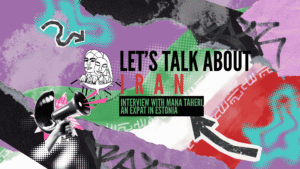
There are conversations that stay with you long after they end. Our recent interview with Iranian activist Mana Taheri was one of them.
In a wide-ranging discussion, Mana spoke about her journey from Iran to Estonia, the reality of life under the regime, the women-led movement that has come to define a generation’s struggle, and why she refuses to stay silent, even when silence would be far safer. What follows is a summary of that conversation, and an invitation to watch it in full.
Watch the full interview on YouTube
From Iran to Estonia
Mana’s story begins with a transition that many in the diaspora will recognize: leaving home not entirely by choice, but because staying became untenable. Moving from Iran to Estonia meant rebuilding a life in an unfamiliar country, learning to navigate a new culture and language, and carrying the weight of everything left behind.
But distance, as Mana makes clear, does not mean detachment. If anything, leaving Iran sharpened her sense of responsibility toward those who remain. Physical safety in Europe came paired with a persistent question: what do you owe to the people you left behind, and how do you use the freedom you now have?
Understanding the Regime
To understand why Iranians are protesting, Mana argues, you first have to understand what the regime actually is, not the sanitized version presented in diplomatic statements or international headlines, but the lived reality of those subject to it.
She describes a system built not only on political control but on ideological control: a worldview that reaches into every aspect of daily life, dictating how people dress, gather, speak, and exist, particularly women. This is a crucial framing she returns to throughout the conversation. The fight in Iran, she insists, is not simply about a government people dislike. It is about an ideology that treats dissent itself as a threat to its survival.
How Today’s Protests Connect to a Longer Struggle
One of the most valuable parts of the conversation is Mana’s insistence on historical context. The protests that have drawn global attention in recent years did not appear from nowhere. They are the latest chapter in a struggle that stretches back decades.
She points to 1981 as the real beginning of the women’s movement against the regime, a starting point often missing from international coverage that tends to treat each wave of protest as isolated and spontaneous. Understanding this continuity matters. It reframes the current moment not as a sudden eruption, but as the resurfacing of a resistance that has been building, adapting, and surviving for over forty years.
It is from this long arc that the rallying cry “Woman, Life, Freedom” (Zan, Zendegi, Azadi) emerges, three words that capture both the specific demands of Iranian women and a broader vision of human dignity.
The First Truth: Oppression
When asked what single truth about Iran she most wants the world to hear, Mana’s answer is unflinching: oppression.
Not as an abstract political concept, but as a daily, grinding reality. The point she makes is that comfortable observers abroad can intellectualise what is happening in Iran, debate it, file it away as one geopolitical issue among many. For Iranians living it, oppression is not a topic; it is the texture of everyday life. She asks the world not to look away from that, and not to soften it into something more palatable.
The Dangers of Being a Voice
Speaking out carries real consequences, and Mana does not pretend otherwise. For activists, journalists, and ordinary citizens alike, raising your voice against the regime can mean surveillance, arrest, violence, or worse — not only for you, but potentially for your family.
This is the backdrop against which her continued activism should be understood. Every public statement, every interview like this one, is made in full awareness of the risk. That she chooses to speak anyway is not recklessness; it is a deliberate act of resistance.
She also speaks to the realities of war and instability, and how conflict reshapes the lives of ordinary people — those who never asked to be on a front line but find themselves living through one regardless.
The Massacre of 2026 and a Generation Rising
Among the most sobering portions of the interview is Mana’s account of the violence of 2026 — what she describes as a massacre carried out against those demanding change.
She details a pattern of repression: mass arrests, internet blackouts designed to cut Iranians off from one another and from the outside world, killings, and the daily execution of young people that, she says, continues to this day.
What makes this especially significant is who is at the heart of the movement. Mana emphasizes that around 60% of Iran’s population is youth, and it is this young generation that is rising up. The regime’s response — to imprison, silence, and execute its own young people — reveals, in her telling, how threatened it is by them. A generation that refuses to inherit fear is the regime’s greatest vulnerability.
What Resistance Looks Like for Ordinary Iranians
Resistance, Mana explains, is not always dramatic. For most Iranians, it is not about grand gestures but about persistence, the quiet, sustained refusal to disappear.
For women in particular, she describes resistance as finding a way to maintain your presence and remain part of society in a system designed to push you out of public life. Continuing to exist visibly, to participate, to refuse erasure — these are themselves acts of defiance. It reframes courage not as a single heroic moment, but as the accumulated weight of countless small refusals, day after day.
Why It Matters to Her, Personally
When the conversation turns personal, Mana is direct about why she continues despite the dangers. Her commitment is not abstract.
“I will always be their voice until we are all free,” she says, a statement that captures the heart of the interview. For Mana, speaking out is not a role she performs but an obligation she carries. As long as people inside Iran are silenced, she sees it as her duty to amplify what they cannot say themselves.
The Best Possible Outcome
Asked what the best scenario would be for Iranians, Mana offers a clear-eyed answer rooted in her analysis of the regime.
For this regime, she notes, even the idea of resistance is dangerous, which is why it works so hard to crush it. The best outcome, in her view, is one where the conditions that sustain the regime collapse, allowing Iranian society to rise again, to come out again and rebuild on its own terms.
She frames the stakes as larger than Iran alone: “We are not only fighting for the freedom of our country, but we are fighting for the freedom of many societies that are in danger because of the existence of this regime.” The regime’s ideology, she argues, is the greater danger, and it does not stop at Iran’s borders.
How Propaganda Works, and Why It’s Dangerous
A significant part of the discussion addresses how the regime’s propaganda operates, and how the framing of the war is consumed around the world.
Mana’s warning here is pointed: do not assume the news tells the truth about the reality of ordinary Iranians. International coverage, she argues, often centers on events that fit a particular narrative while overlooking the human cost borne by Iranians themselves. As she puts it, observers may feel sorrow over certain bombings while remaining unmoved by the thousands of people murdered by the regime.
The antidote, in her view, is to go directly to the source.
Where to Find Reliable Information
So how should people outside Iran find trustworthy information? Mana’s advice is consistent with everything else she says: follow real people and their voices.
Rather than relying solely on major news outlets, she encourages listening to Iranians themselves, the community, the people living the reality day to day. “You need to hear from the community, from the people,” she says. It is a call to shift the center of gravity in how we understand Iran: away from distant analysis and toward direct testimony.
She also speaks warmly about how Iranian activists abroad approach their host societies, making genuine efforts to raise awareness in ways that are culturally and linguistically inclusive, respecting the communities that have taken them in while advocating for those back home.
A Message to the World
In her closing message to the international community, Mana asks for something both simple and demanding: attention that does not fade, and solidarity that goes beyond the news cycle. The people of Iran, she reminds us, are not a headline. They are a population, disproportionately young, fighting for the most basic freedoms, often at the cost of their lives.
Why We Made This Interview
At our organization, we believe that amplifying firsthand voices is one of the most meaningful things we can do. Reports and statistics matter, but they cannot replace the testimony of someone who has lived the reality and chosen to speak about it openly.
Mana Taheri’s words are a reminder that behind every news item about Iran are real people, making impossible choices, taking real risks, and refusing to give up. We are grateful she trusted us to share her story.
Watch and Share
We encourage you to watch the full interview and, just as importantly, to share it. As Mana herself emphasizes, the most powerful thing outsiders can do is help carry these voices further.
Listen. Share. And don’t look away.
If you would like to learn more about our work or get involved, get in touch with our team. To connect with Mana Taheri directly, her contact information is available here.