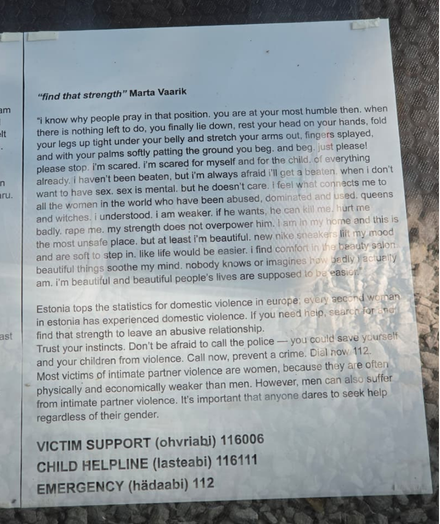
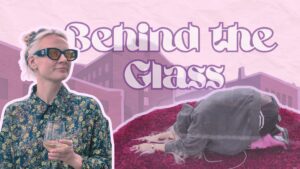
My friend and I were taking a leisurely stroll through Telliskivi when we walked past an unusual sight. There were two women lying face-down on a deep red carpet with their bodies folded forward and arms stretched out in front of them.
At first, without context, it was difficult to understand exactly what I was looking at. I asked my friend if she knew what it was, and she casually told me that the installation had already been there for months. Somehow, I had never noticed it before. We stopped to read the text displayed beside the women, and suddenly the scene in front of us made sense.
The installation was called “find that strength” by Estonian artist Marta Vaarik. The work addresses domestic violence and the vulnerability, fear and isolation experienced by those living in abusive relationships. The position of the women was deliberate. In the accompanying text, Vaarik describes it as a position of prayer and complete humility: when there is nothing left to do, you make yourself small, put your head down and beg.
Seeing those words beside actual women holding that position evoked so many emotions. I felt helpless and emboldened and terrified. Why is this so easily relatable?
When home isn’t safe
One of the lines from the installation stayed with me: „I am in my own home and this is the most unsafe place.“
Home is supposed to be where we feel safe – yet for so many people, it simply isn’t.
We often hear the same questions repeated when we talk about abusive relationships. Why doesn’t she leave? Why does she stay? Why doesn’t she call the police? From the outside, these questions can seem reasonable but the answers are rarely simple when we step into the shoes of someone inside an abusive relationship.
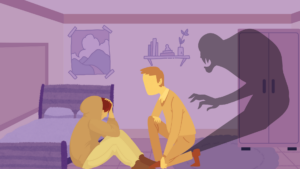
There may be a justified fear of what happens if you try to leave. There may be children involved, financial dependence, threats, and isolation. Maybe it feels as if there is nowhere else to go. Sometimes, even recognising that what is happening to you is abuse can take time.
This is what struck me about Vaarik’s words. There is fear in them, but also an awareness of how complicated that fear can become when it exists inside your own home and within a relationship that is supposed to make you feel safe.
In the middle of Telliskivi
The location of the installation makes it even more striking.
Telliskivi is the place we associate with restaurants, bars, markets, events, art – spending time with friends and family. It’s somewhere you go for a nice day out, which is what my friend and I were doing when we came across the installation.
Right there, in the middle of all the activity, were these two women on the floor.
People could and were walking past them. You could stop and watch through the glass, read that story and then continue with your day.
I found that uncomfortable.
Isn’t this exactly what happens with domestic violence? It exists around us while the rest of life carries on. We know it happens. We hear about it on the news or from friends of friends. We may even know somebody who has experienced it, whether we were aware of it or not.
The installation takes something that usually happens behind closed doors and puts it somewhere where we have to see it.
Finding that strength
At the bottom of the installation are three numbers: victim support, the child helpline, and emergency services.
I think their inclusion matters. The installation is confronting, but it also gives someone who might recognise themselves in those words somewhere to turn.
The title „find that strength“ stayed with me, too. It is easy to tell someone to leave a difficult situation when you are not inside it. Finding the strength to leave and change your circumstances can mean overcoming fear, manipulation, dependence and uncertainty of what comes next.
And perhaps those of us standing on the outside have a responsibility here as well.
This installation made me think about how closely we pay attention to the people around us. Do we notice when our friends and family are withdrawing? Do we listen when someone tries to tell us that something is wrong? Do the people we love know that they can come to us without being judged or immediately questioned about why they stayed?
We cannot know what is happening behind every closed door, but we can listen better. We can take people seriously. We can make sure that the people around us know that if they ever need somewhere safe to turn, we will be there.
Maybe finding that strength becomes a little easier when you know you don’t have to find it alone.
About Marta Vaarik
After seeing „find that strength,“ I wanted to know more about the woman behind it.
Marta Vaarik is an Estonian interdisciplinary artist based in Tallinn whose work often engages with social issues, including womanhood, relationships, and inequality. She has spoken about wanting her art to be accessible to a wide audience, without requiring any particular knowledge of art to understand it.
That feels especially true of „find that strength.“ I didn’t need someone to explain the symbolism or tell me how I was supposed to feel. I saw two women on the floor, read the words beside them, and understood.
I am grateful that I happened to walk past it.
Where to find help in Estonia
If you or someone you know is experiencing violence or abuse, support is available:
- https://www.palunabi.ee/et
References