The murder of the curious kid
I was around 12 when my mum took me to the gynaecologist for the first time. I was a curious kid, so even lying there in that awkward, very exposed position, I wanted to understand what was going on.
“So, um, this white discharge I get down there … is it normal?” I asked.
My mum jumped in straight away: “These kids, they read all this stuff on the internet now and come up with these questions!”
The gynaecologist gave me a side-eye. Pursed her lips. Sighed heavily.
“Yes, it’s normal,” was her answer. Not in a particularly friendly tone, either.
I didn’t give up.
“Will it always be like that?”
“No, not always! When you get old and your vagina dries out, there won’t be any more discharge!” the lady snapped.
That was my cue to shut up.
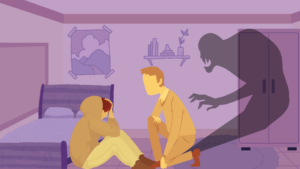
Nobody actually told me to stop asking questions. They didn’t need to. It was pretty clear that this was not a topic anyone wanted to discuss, and that I shouldn’t look too closely at what was happening down there. “Be ashamed of yourself, you little girl with your stupid questions.”
That episode was enough to kill any interest in my menstrual cycle, the thing my body does every single month, for about 20 years.
The suspicious white stuff
Somewhere around the ripe young age of 33-ish, my curiosity came back. Maybe it was the funny ovulation reels; maybe it was an influencer cooking “follicular phase recipes”. I honestly don’t remember. What I do remember is thinking: isn’t it weird how little I know about something that happens to me every month?
So I started reading. And, oh boy, what a rabbit hole I fell into. At some point, I landed right back at my 12-year-old question. What *is* that white stuff, goddamn it? Behold, it has a name – cervical fluid. I also finally learnt what a cervix actually is. For the first 30 years of my life, I had a rough idea at best. And cervical fluid is not just something your body produces to ruin your underwear. It changes throughout your cycle. It contains mucins, huge proteins that build a kind of mesh, and that mesh changes its structure depending on the phase of your cycle. Around your fertile window, the fluid becomes much friendlier to sperm and actually helps them get through the cervix. At other times, it gets thick and blocks unwanted trespassers.
So sperm can come in, but on her terms. Hehe.
And that’s only one of her jobs. Cervical fluid also contains proteins, electrolytes, enzymes and antimicrobial substances that help keep infections out. Honestly, if you read the ingredient list, you’d think it was a fancy health drink. Or a post-workout shake for gym bros. Do with that thought… whatever you want.
But the part that really surprised me was this: you can use it as your own personalised biological tracker. Because it visibly changes throughout your cycle, simply paying attention to its viscosity, amount and colour can tell you something about what your hormones are up to and when you might be getting close to ovulation.
Look at your discharge. Sounds a bit gross, right? But why does it, actually? We track our steps, our sleep, our heart rate, our calories and our HRV. We don’t think twice about other things our bodies produce, like sweat or tears. Yet looking at this particular fluid is somehow “ew”.
And there I was, back in that gynaecologist’s office. Nobody ever told me my discharge was disgusting. Nobody had to. I picked it up from the awkwardness, the side-eye and the snappy answers. And then it probably happened a hundred other times, in other tiny encounters, conversations, film scenes, internet memes and song lyrics. Reinforced and locked into the shame, the stigma. That’s how culture works.
Follow the white rabbit
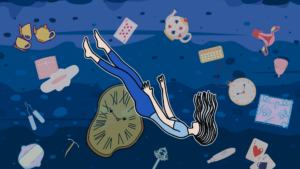
Cervical fluid was my first rabbit hole. Since then, I’ve gone down dozens more, and almost every time I end up thinking: HOW THE HELL did I not know this about my own body?
And I’m not talking about super-complicated medical stuff. I mean things I can see and feel. I started to recognise when I’m ovulating, and now I schedule my content creation for that phase. I changed my diet and got rid of the lower back pain I used to get for several days before my period. PMS stopped being this random glitch that showed up out of nowhere and became something I got curious about. Now I lean into it instead of fighting it. Suddenly, I understood things that used to just happen to me, and I had more empathy for my body.
I also got angry for the little 12-year-old me, robbed of this knowledge. Imagine little me asking about the white discharge and the doctor saying something like: “Good question, actually. It’s called cervical fluid. Your cervix makes it, and you’ll probably notice that it changes during the month. That’s your hormones at work as you move through the phases of your cycle. Your body is doing something pretty clever there.”
Would that one answer have changed my life? Probably not. But I think it might have changed how I relate to my body. Maybe I would have learnt “pay attention and be curious” instead of “don’t look; hide your shame”. Maybe my reproductive system wouldn’t have felt like some mysterious machinery below my belly button that occasionally bleeds, hurts or produces weird white stuff.
I really don’t think my mum or that doctor meant to kill my curiosity. That’s what I find so interesting about it. No one ever explicitly told me that periods, discharge, vulvas and vaginas are embarrassing. A look and a dismissive answer from two authority figures, at a moment when I felt vulnerable, were enough.
The curious kid strikes back
It took me 20 years to start asking again, and thank God I did. Along the way, I discovered that I’m not the only one asking those questions. When I started sharing these rabbit holes on Instagram, one of my videos got three million views, and my page grew to 10,000 followers organically, without a single paid ad. To me, that says one thing: women are not uninterested in their bodies. We’re curious as hell. We just weren’t always invited to be.
So here’s your invitation. I’m going back down the rabbit hole, and this time I’m asking all the inappropriate questions. Hold my hand; we’re in for a ride.
Welcome to “Your Period Has a PR Problem”!