‘Nature’ has often been, historically, invoked to justify mistreatment of women. Whether it has been ‘a woman’s nature’ or ‘the natural role of a woman’, curiously, more often than not, these interpretations of ‘a woman’s natural place’ have rarely been founded upon actual wildlife observations.
The way I perceive natural processes, a female is at the centre of all social and political activity. Females’ needs and preferences (where she wants to live, how and with whom), largely determine the species’ distribution, ecology, behaviour, and evolution.
In most if not all mammal and bird species, male evolution and social activity are nothing but adaptations to what the females want. In fact, males must be so well-adapted as to predict females’ wishes and anticipate them. Males do not wait to be ‘bossed around’ or told what to do. Since a young age, they attune their bodies and minds to perceive the female’s condition.
If a male cannot predict what the female wants, he is, to an extent, pushed to society’s margins, for the simple reason that societies tend to form and revolve around females (or female-favoured habitats and resources). And if the male does not know what females fancy, he cannot find them – and with them, any true social ‘hangouts’.
Beauty and Charming
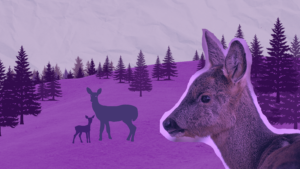
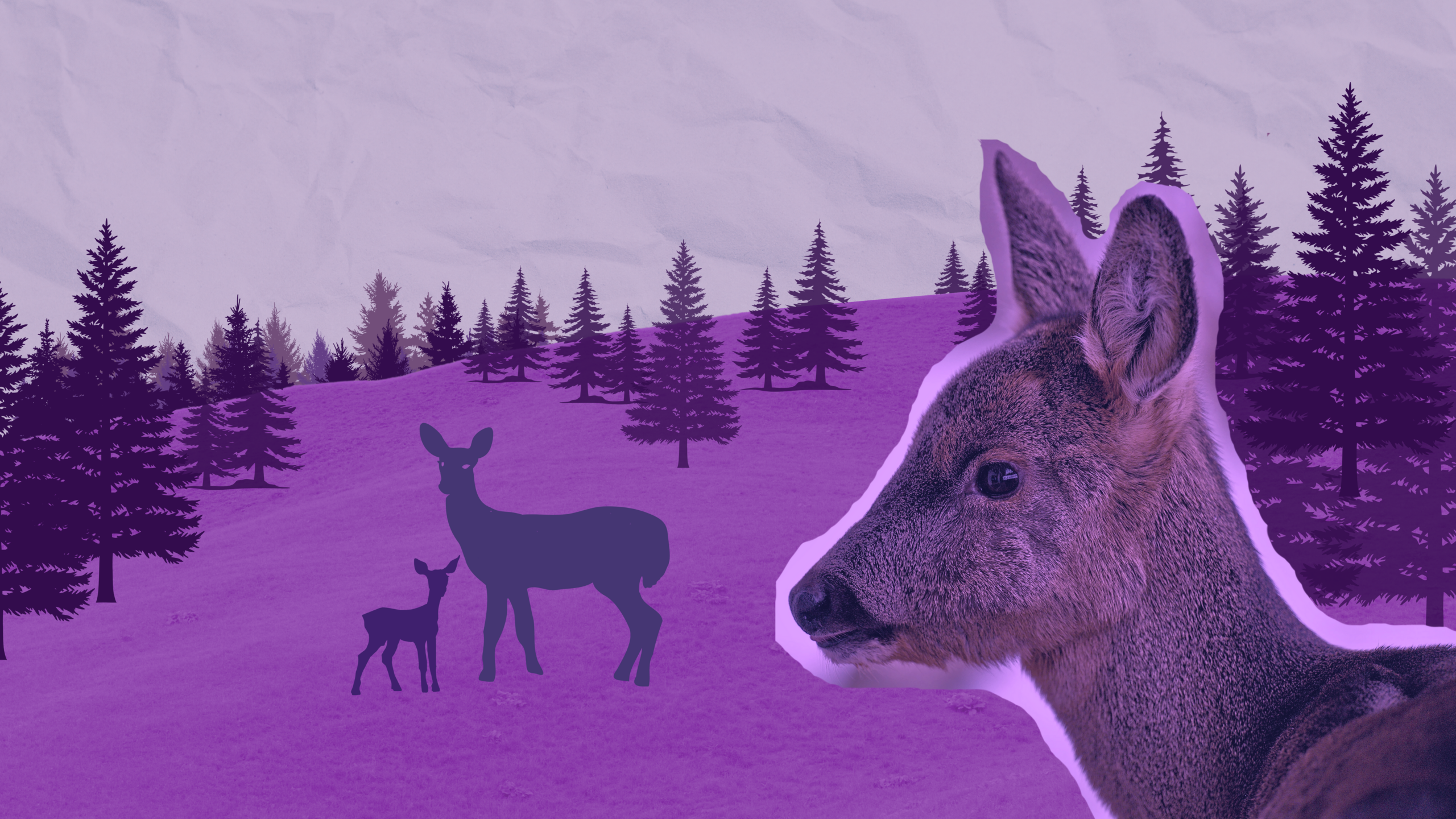
In this article, I would like to tell a story about a roe deer couple, my friends, whom I have named Beauty and Charming and who represent, as I have named their home, the Hayfield Orchard family.
I would like to demonstrate the level of dedication by Charming to his wife Beauty in her endeavours to pursue a vocation. It has been a devotion of such intensity so as to challenge evolution, history, traditions – not to mention, Charming’s own social standing.
Charming and Beauty are the local power couple in their area. They are biologically superior to their neighbours and they inhabit the top quality local habitat. They are on the larger side (especially Charming), healthy, and good-looking. This has been both a blessing and a complication in Beauty’s life.
A Career of Being Caring
Beauty is a female whose inner ambition to take care of others has been greater than she can express with regard to her own family alone.
I have purposefully articulated it as an ‘ambition’ because, in human societies, caretaking has rarely been regarded as a professional vocation. We want to be lawyers, doctors, or teachers. That is how we understand careers and public accomplishment. When asked, at school, what we want to do in our lives, we are not supposed to reply, ‘I want to be kind and caring.’ (Girls, in particular, are ‘kind and caring by nature’, so there is no effort involved – and any kind, caring girl is just a ‘self-evident phenomenon’, certainly not an achievement.)
Let us consider, for a moment, the inner drive to be caring as a career path.
From such a perspective, women in the human history, whether due to an inherent propensity to show kindness or due to a social enforcement of gender roles (‘good women must be serving and nice’) have been, professionally, incredibly advanced.
Why? Because, in order to carry out the occupation of taking true care of individuals, a rather futuristic, integrative, interdisciplinary approach is needed. An approach which we are beginning to grasp only now, in the 21st century.
It is an approach within the context of which the individual who is being taken care of, is viewed as an actual holistic organism and not as an assembly of units.
Namely, to take care of a living being, medicine has to go hand in hand with cooking, financial management, education, music, and so on, and so forth while the ‘male professional method’ has often been that of treating people as if they were mechanisms which can be disassembled and dispatched to the respective servicemen (the body gets sent to the doctor, the soul to the priest, the spirit to perhaps the university or to the tavern, while a woman would try to fit the hospital, church, school and tavern all into her own ‘little kitchen’).
Because we do not recognise the inherent need to take care of others (and other passions) as professional ambition, these advanced, ahead-of-their-time, creative, adaptive, holistic workers are usually still not paid, nor are they sufficiently praised, nor is it seen as a public investment because an apron is not a uniform and a child who got through the winter without a sneeze, is not a certificate.
The Obstacles Beauty Faced
Be that as it may, Beauty does experience this intense need to take care of others.
Usually, we would assume that being ‘rich and healthy’ would only guarantee such opportunities.
Unfortunately, not so much in the roe deer species.
The official scientific theory states that stronger individuals are feared by weaker ones.
I disagree. My observations have led me to believe that roe deer have developed a ‘double justice insurance’ in which strength is viewed as either biological or social and those individuals who are biologically strong are not so socially.
Social power is given over to the more vulnerable individuals who engage in a greater number of interactions and who, thereby, gain social expertise.
During spring and summer, the biologically superior families lead a somewhat more secluded life than others – in their own biologically superior homes.
Their duty is to preserve the best traits and behaviours of the species, to showcase them, and to take care of the most valuable habitat. This is often the habitat upon which the rest of the region depends to sustain a healthy environment, to ensure seed dispersal, to mitigate local climate, etc. (It is ‘the Amazon rainforest’ to ‘the planet Earth’.)
Meanwhile, those who inhabit less optimal habitats and who are perhaps not physically strong enough to properly safeguard the wildest estates, tend to be more flexible in their social activity, and they make the local social decisions whereby, in my view, they become socially dominant.
During autumn, the biologically stronger families are integrated into the local community but they follow the social lead by the weaker families. Thereby, the social power balances out the physical power and, because socialising is a dynamic process, there is the additional benefit of annual adjustments in the power structure, in comparison to the steady biological baseline that does not change much year to year.
You might agree with the scientific explanation, or with mine, but the point is that Beauty, who wished dearly to take care of more than her own fawns but who would never deprioritise her home and her children, simply represented the ‘wrong type of power position’ to ensure such social activity on her home range.
It was making her sick. Beauty’s passion and compassion (she was not living as remotely from her neighbours so as to not discern how poorly many of them were doing) were beginning to compromise her welfare, and while there were no apparent health complications, during the year of 2023, she almost died and her fawn was born quite feeble. (To bring a worrisome story to a happy ending, the fawn slowly but determinedly grew up to be a great beauty and a cheerful young lady whom I named Rosebud.)
Charming’s Dedication to His Wife’s Social Ambition
I could see how troubled Charming was. It is thought that roe deer males are not particularly bothered by their children, nor with the females outside of the rut period, but such has never been my experience.
I believe Charming began to realise that his wife needed society, and that for her and her children to survive, they had to overcome their ‘nobility’.
Coincidentally, Beauty represents a roe deer ecotype (grey coat, medium-sized, a more compact body, a propensity to jump very high and not to cross large open fields) which is a forest ecotype, and, according to my observations, these roe deer are more sociable than other roe deer.
Roe deer who live on crop fields, for instance, gather in large groups every day, autumn through winter. However, when they have spent some time socialising, they each scatter back to their own little homes in the sparse groves by the river.
Meanwhile, I have observed that Beauty’s genetic lineage is characterised by a behaviour of sticking together during the winter period, day or night, active or resting. Several families travel together, and they form what might be termed a winter tribe. They take care of each other, related or unrelated, and they share their resources.
I believe Beauty was born in a family neighbouring the Hayfield Orchard range (the Wild Woods family) and in this family I have witnessed precisely such winter behaviours.
Beauty might have felt a physical need to be more social, however, her need surpassed the winter caretaking opportunity. She wanted to help the local fawns already during summer.
In our society, Beauty might have set up a day care, a kindergarten or a school in her home.
But in her society, different rules and duties exist. Rules that are important because they ensure that what is beautiful and healthy and strong persists and multiplies.
Beauty’s husband, Charming, began inventing clever methods that allowed him to ‘trick’ evolution and tradition so that his wife could pursue her inner passion, social interests and career of care.
This article is dedicated to Beauty. There would be much to tell about how crazily inventive Charming was, how he went out of his way to humble himself so that biologically inferior individuals could ‘invade’ the Hayfield Orchard home.
Fawns do, at times, interact on the margins of summer home ranges but the fawns do not venture deeper into neighbouring areas, and the parents would not let them, either, unless they were accompanied. But adult neighbours do not ‘trespass’ into other roe deer homes during the fawning season.
Charming had to ensure that the neighbouring families could arrive at his home and use his range, and he had to pretend to be inferior to these neighbours – not only on behalf of himself but also on Beauty’s behalf (as he represented them as a couple).
Charming, this large, courageous, handsome, healthy, flawless male, was making himself appear small, timid and insecure, so as to ensure his wife’s social aspirations.
A behaviour that, by the book of any wildlife specialist, would even endanger his own ‘masculinity status’ in his wife’s eyes, and thus, his reproductive and social security.
But clearly, his wife’s wellbeing was more important to Charming than any ‘biological imperative’. He was prepared to risk everything, including their marriage, to see her thrive.
It should be noted that social dominance by the vulnerable may have balanced some of the power hierarchies, but Charming began his efforts in March already.
In spring/early summer, all roe deer families, ‘rich or poor’, lead private lifestyles, and any considerable socialising typically begins well into July, at the earliest. The poorer families begin to socialise earlier, but not until after June.
Beauty’s Dream Comes True
To make a long story short, by the end of June, at least three fawns (to my knowledge) from three different neighbouring families were visiting with Beauty and her twins frequently (every week or every other day), and Beauty was mothering them to her heart’s satisfaction.
These fawns were being treated as family members, and Beauty’s own (big, healthy, good-looking) twins protected them and ensured that they felt safe and cosy. For example, when sleeping together on a hayfield, the twins always tucked the guest between them where they could watch over the guest from both sides, and offer warmth and attention.
Beauty, of course, never divorced her wonderful husband who had risked everything and who had (innovatively) defied hundreds, maybe thousands of years of evolution, to grant her the freedom to be who she wanted to be.
In truth, the entire local roe deer community jeopardised their historical (environmental) values for Beauty’s sake, because, I expect, they realised that nature could not be protected without protecting a woman’s dream – to protect nature was to protect this dream.
(After all, Beauty is an epitome of ‘the perfect roe deer female’, but under conditions of securing ‘the perfect world’, she was dying.)
The local habitats, however, did not come to suffer any hazard because roe deer are very polite and considerate. (A young male once ran past by me as close as 1.5 metres (a behaviour dangerous for him) to avoid intruding into another family’s nursery area.)
After having ensured that their fawns were safe and looked after in Beauty’s home, the parents and the older siblings watched them from the margins or more public areas, and the adults avoided proceeding deeper into the Hayfield Orchard range.
It must be mentioned that fawn sleepovers or fawns journeying with another family are uncustomary at best. During winter, fawns do mingle with other fawns and with other youths and adults but, at all times, under close presence and supervision by their mother (and father, older sister etc.). Roe deer do not really relinquish their children into someone else’s care, without accompanying them.
Be a Part of Beauty’s Professional Growth
Sometimes when I go for walks in areas where I see fawns who live in a grove of five trees surrounded by the barren ‘moonscapes’ of industrial crop fields, I encourage them by saying, “When you go to sleep, close your eyes and call on Beauty. She will tell you about wild forests that she knows in her blood. Forests through which happy rivers run, whose laughter is the laughter of all fawns, yours, as well. Forests in which nobody can come and take your mother, your father or your home away from you. Forests in which women’s dreams are of the utmost importance.”
Beauty and Charming live in Latvia. But if you meet a roe deer child in Estonia, you can pass the message along. I am certain that Beauty’s professional ambition and Charming’s supportiveness of his wife do extend that far.